
 Fuji V10, Lomo - views from the plane
On the 14th of May, I took a five hour Silkair flight to
Chengdu (also click
here) the capital of
Sichuan to begin my ten day visit of the province. After we were greeted at the airport by the local Sichuan guides, the lot of us that flew over from Singapore were split up into two buses. The reason for that was because in the larger group that flew with the tour agency from Singapore, a portion of the group was booked on the eight day tour which excluded
Emei Mountain, a portion was booked for the ten day tour which included Emei Mountain and a group of five was booked on the ten day tour which went to the
Shunan Bamboo Sea instead of Emei Mountain. I was with the ten day group that went to Emei Mountain. Travelling with me was a friend from Singapore who prefers to go by her online nickname of Oddfatty. =)
There were 27 people in our group and travelling with us were the Singapore guide Lucy, the Sichuan guide Tu Xin, a trainee guide from Sichuan Zhao Dan and two drivers Shen Sifu and Ren Sifu. Apparently, for long bus journeys, like the one I would be traveling on on our way to Jiuzhaigou, tour buses will need to switch between two drivers. This made me feel safer as I'd heard many a horror story involving accidents on the long winding mountainous roads to Jiuzhaigou.
We arrived in Chengdu in the middle of the afternoon, at about 3pm and our first stop for the day was
Jinli Street (also click
here). Originally, we were suppose to visit the
Furong Ancient Town where we were suppose to watch a bianzhong bell ensemble performance but according to the guides, Furong Ancient Town is currently embroiled in a court case, so no bell ensemble performance and hence, the change to Jinli Street. It's a pity. I would have liked to have visited Furong Ancient Town and to view a bianzhong bell ensemble in person. The only time I remember seeing one was on TV and I think it was in a TVB series called Where the Legend Begins (洛神) and this being a TVB series, I highly doubt its authenticity.
 A photo of these ancient bells. A pity I wasn't able to view this performance.

 Canon 300D - A stone sign which says translates into "Scared Ground of the Three Kingdoms", shots of the street just outside of the entrance to Jinli Street
Anyway, back to Jinli Street. Jinli Street is next to the
Marquis Wu's Memorial Temple (Wuhou Memorial Temple) which is a temple that is dedicated to the crafty and highly intelligent
Zhuge Liang who was the Martial Marquis of the
Kingdom of Shu during the period of the
Three Kingdoms in China's history. Chengdu was then the capital city of the Kingdom of Shu and the Wuhou Temple stands as a testament to the rich history of Sichuan and the city of Chengdu.


 Canon 300D - Sign introducing Jinli Street, entrance to Jinli Street, the door knob on the large wooden doors that flank the entrace to Jinli Street, little street stalls outside the entrance.
Jinli Street isn't very big but what this 350m street lacks in length, it more than makes up for in history. Jinli Street has a history that dates back to the
Qin Dynasty which is some 2000 years ago!! During the period of the
Three Kingdoms, Jinli Street was one of the busiest commercial streets in the
Kingdom of Shu. Jinli Street's reputation then was closely tied to silk, more specifically the much sought after
Shu Brocade.
 Photo of a piece of Shu Brocade
Sadly, even though Jinli Street used to be famed for its silk, I actually don't remember seeing a lot of silk. But then again, I'm not much of a shopper and I really didn't enter that many shops so it is quite possible that I missed them. We were only given an hour anyway, so I busied myself walking through the street and snapping a few pictures of the rather pretty buildings and looking at some of the local street food for sale in the section of Jinli Street that sold food.
Although this didn't have the more authentic feel of the two old towns I visited in Guizhou (and yes, I do remember that I've yet to put those photos up :-) ), still the glossy varnished wood and the higher two-story buildings which grace both sides of the street really did resonate elegance and convey a sense of the prosperity this street must have known in the past.


 Canon 300D - Jinli Street and yes, Starbucks is everywhere
 Canon 300D - a child plays in Jinli Street oblivious to everyone around him


 Lomo - Jinli Street
Apparently, the street was restored by contributions from the adjoining Wuhou Memorial Temple and then reopened in 2004 to the public. The new Jinli Street's buildings are modeled after traditional houses in the Sichuan architectural style from the
Qing Dynasty so if I understand it correctly, the buildings themselves aren't really that old, just that they look like the traditional buildings from the past. Still, Jinli Street isn't without its more traditional charms. It's filled with little shops that sell traditional ware like
Sichuan Opera (川剧) masks and figurines and little street carts offering traditionally made candy and paintings. There is also a little pavilion by a pond and a stage for Sichuan Opera. Apparently they have opera performances in the evening everyday but we were probably there at the wrong time and unfortunately didn't have the opportunity to watch one.


 Canon 300D - Making candy, the little pond and the opera stage
What I also found quite interesting was the section of Jinli Street that sold Sichuan street food. My friend and I did buy a stick of "bingtang hulu" (冰糖葫芦). "Bingtang hulu" is candied fruit from the Chinese hawthorn plant and part of the reason why I am fond of this kind of candied fruit is because it's mentioned in several martial arts novels. The one we bought at Jinli Street is very tasty and the best I've eaten. We also bought some
Dragon's Beard Candy, which is type of candy that I'm particularly fond of. The one we bought in Jinli Street is really rather nice and the threads of sugar are spun so finely that they melt in your mouth. The filling is a little different from the ones I've had in Singapore but I can't really identify what that difference is.


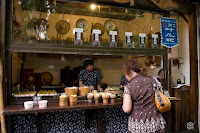
 Canon 300D - street food stalls in Jinli Street, bingtang hulu
 Lomo - street food stalls in Jinli
 Canon 300D - Dragon's Beard Candy
 Fuji V10 - Strawberries bought from fruit sellers near where the tour buses are parked
After our short trip to Jinli Street, we went off for dinner. The dinner was actually rather nice and I quite enjoyed it. Instead of just giving us the usual tour food dishes of vegetables, soup, fried eggs etc, the guides arranged for the restaurant to serve us several small dishes of more traditional Sichuan food. So we had several types of noodles and dumplings which I rather liked and found quite tasty. Luckily I ate a pretty full meal then as the food from here on to and back to Chengdu from Jiuzhaigou was mostly not very good at all.

 Fuji V10 - Shui Mi Tao, a type of peach sold by a fruit seller outside the restaurant, a building in Chengdu
After dinner, we went to watch a Chinese musical called Jinsha and I'll talk about that in the next entry on Sichuan.
Later guys... cheers. =)


